
Bitcoin political support is attracting renewed attention following the 2026 U.S. midterm elections, with Strategy Executive Chairman Michael Saylor highlighting an important development that could influence the cryptocurrency’s long-term future. According to Saylor, recent election results suggest that interest in government-held Bitcoin reserves is no longer limited to one political party.
The billionaire Bitcoin advocate pointed to developments in Florida and Texas, where newly elected officials from opposing political parties have previously supported Bitcoin reserve initiatives.
His comments arrive as the cryptocurrency industry continues to monitor Washington’s changing political landscape and the potential impact of future digital asset legislation.
Michael Saylor Highlights Growing Bitcoin Support
In a November 4 post on X, Saylor shared his perspective on the latest U.S. election results, identifying two examples of political support for Bitcoin.
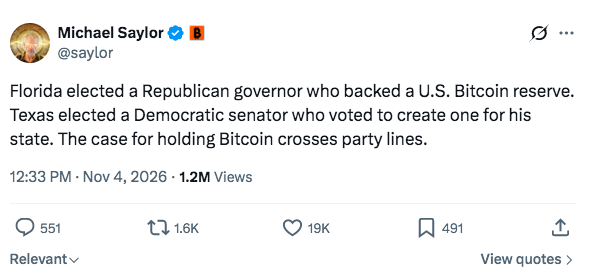
The first involved Florida, where Republican Byron Donalds won the gubernatorial election after previously supporting legislation to establish a federal Bitcoin reserve.
The second involved Texas, where Democrat James Talarico secured a U.S. Senate seat after voting in favor of legislation establishing a state-level Bitcoin reserve.
Saylor wrote:
“The case for holding Bitcoin crosses party lines.”
The statement reflects Saylor’s view that Bitcoin is becoming an increasingly important financial and policy consideration for lawmakers across the political spectrum.
While Republicans and Democrats continue to disagree on several aspects of cryptocurrency regulation, the election results provide examples of politicians from both parties supporting initiatives involving government-held Bitcoin.
This development follows earlier discussions about the Bitcoin reserve, including comments from White House digital asset adviser Patrick Witt about bipartisan interest in establishing a more permanent federal framework.
For Bitcoin supporters, the growing attention from elected officials represents another development in the cryptocurrency’s transition from a relatively niche asset into a subject of national financial policy.
Could Bitcoin Reserves Gain More Attention In 2027?
The political developments in Florida and Texas could become particularly relevant as lawmakers prepare for new legislative sessions in 2027.
Donalds previously supported federal legislation aimed at formalizing a Strategic Bitcoin Reserve, while Texas has already established a legal framework for holding Bitcoin as part of its state reserve strategy.
The Texas initiative is especially notable because it demonstrates that state governments can consider Bitcoin-related financial policies independently of federal legislation.
Meanwhile, Florida’s new administration could bring renewed attention to reserve proposals that did not advance during the previous legislative session.
As previously covered by Bitcoinist, the proposed reserve legislation has included measures addressing long-term Bitcoin custody, government oversight, and the management of digital assets held by federal agencies.
However, political support does not guarantee that additional reserve legislation will pass. Lawmakers must still consider public spending, custody security, market volatility, and the appropriate role of digital assets in government finances.
These questions could become central to future debates as policymakers evaluate whether Bitcoin should play a greater role in public reserve management.
What Does This Mean For Bitcoin’s Future?
Saylor’s latest remarks come at a time when Bitcoin’s relationship with traditional financial institutions and government policy continues to evolve.
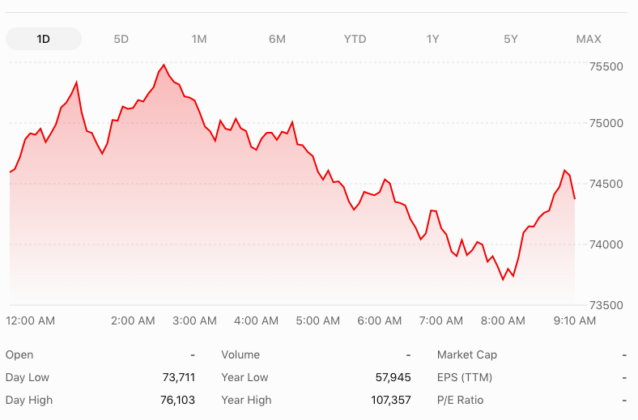
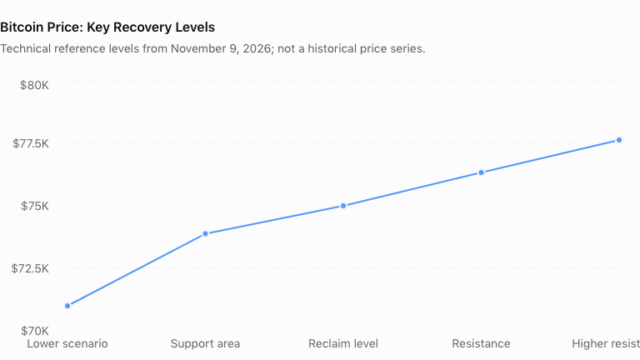
Bitcoin (BTC) price performance following the 2026 U.S. midterm elections.
The creation of a U.S. Strategic Bitcoin Reserve through a 2025 executive order marked an important development in federal digital asset policy.
According to the White House order, the reserve was designed to manage government-held Bitcoin, including assets obtained through forfeiture proceedings.
The order also authorized officials to explore budget-neutral strategies for acquiring additional Bitcoin, although it did not establish an unrestricted government purchasing program.
Bitcoinist has previously examined how a potential reserve announcement could influence discussions about the government’s approach to digital assets.
For investors, developments involving Bitcoin reserves are worth monitoring because they could affect the asset’s long-term adoption narrative and perceptions of institutional legitimacy.
Still, government interest alone does not guarantee higher prices, and Bitcoin remains sensitive to broader financial conditions and investor sentiment.
The latest midterm results also leave important regulatory questions unresolved, particularly as the new congressional balance could influence the future of cryptocurrency legislation.
Nevertheless, Saylor’s observations highlight an important distinction: support for Bitcoin-related policies can emerge from politicians with different political priorities.
As the United States prepares for another legislative year, the next major development may be whether this cross-party interest translates into concrete Bitcoin reserve policies.

You can get bonuses upto $100 FREE BONUS when you:
💰 Install these recommended apps:
💲 SocialGood - 100% Crypto Back on Everyday Shopping
💲 xPortal - The DeFi For The Next Billion
💲 CryptoTab Browser - Lightweight, fast, and ready to mine!
💰 Register on these recommended exchanges:
🟡 Binance🟡 Bitfinex🟡 Bitmart🟡 Bittrex🟡 Bitget
🟡 CoinEx🟡 Crypto.com🟡 Gate.io🟡 Huobi🟡 Kucoin.










Comments